- Why “Running Wheel” Is Worth a Closer Listen Right Now
- Who Are Creepy Nuts?
- “Running Wheel” at a Glance
- Lyrics Meaning, Part 1: “Kemonomichi,” the Path Nobody Paved
- Lyrics Meaning, Part 2: “Chosen One” and the John Cena Line
- Lyrics Meaning, Part 3: Writing “Coachella” Into the Record
- Lyrics Meaning, Part 4: What the Title “Running Wheel” Means
- What Creepy Nuts Said About Making It
- How Critics and Fans Heard It
- The Takeaway: What “Running Wheel” Is Really Saying
- FAQ
Why “Running Wheel” Is Worth a Closer Listen Right Now
On November 20, 2026, Creepy Nuts release their first-ever film in Japanese cinemas: Creepy Nuts – NORTH AMERICA TOUR: LIVE in NY & DOCUMENTARY FILM. Directed by Hiroya Brian Nakano, who has shaped the duo’s photos and videos for years, it combines a documentary of their first North American tour, including their April 2026 Coachella debut, with footage from their first headline show in New York. The day after the premiere, November 21, there is a stage greeting at TOHO Cinemas Shinjuku in Tokyo, broadcast live to cinemas across Japan.
That makes this a good time to revisit “Running Wheel,” the single Creepy Nuts released on August 19, 2026. It was written for a Honda car commercial, but the duo said they filled the lyrics with “recent events.” DJ Matsunaga went further in an interview with the UK magazine Clash, describing the song as being about their experiences at Coachella and on their international dates. If the film shows that spring on screen, “Running Wheel” is R-Shitei’s written record of it.
In this guide we’ll unpack what “Running Wheel” means: its key words, the double meaning of the title, what the duo have said about it, and how critics in Japan and abroad heard it. We won’t reproduce the lyrics, only a few single words needed for the discussion.
Want to hear it first? Listen to the song here.
▶ More music videos and live clips are on the official Creepy Nuts YouTube channel. The song is also available on Spotify, Apple Music, and other streaming services.
Who Are Creepy Nuts?
Creepy Nuts are a Japanese hip-hop duo made up of rapper R-Shitei and producer/turntablist DJ Matsunaga. R-Shitei, from Sakai in Osaka Prefecture, built his name in freestyle battle rap and won Japan’s biggest battle tournament, UMB, three years in a row. DJ Matsunaga won the DMC World DJ Championships in 2019. Most overseas fans met them through “Bling-Bang-Bang-Born,” the opening theme of the anime Mashle: Magic and Muscles, which has passed 900 million streams worldwide. In February 2026, it and “Otonoke” (from the anime Dan Da Dan) made Creepy Nuts the first Japanese artists to earn RIAA Gold certifications for two separate Japanese-language songs.
Cultural Note: Japan’s MC Battle Scene
Freestyle rap battles are a big deal in Japan. UMB (Ultimate MC Battle) is the long-running national tournament, and wins there earn real respect in the underground. In the 2010s, the TV show Freestyle Dungeon brought battle rap to mainstream Japanese television, and R-Shitei was one of its best-known figures. That background matters for “Running Wheel”: it is a song about getting from small, sweaty battle venues to the world’s biggest festival stages without ever pretending the starting point was glamorous.
“Running Wheel” at a Glance
| Detail | Info |
|---|---|
| Release | August 19, 2026 (digital; music video released the same day) |
| Lyrics / Music | R-Shitei / DJ Matsunaga |
| Tie-in | Honda N-BOX CUSTOM TV commercial, “NEW IMPACT” spot (on air from July 16, 2026) |
| Sound | A track built on elements of phonk |
| MV director | Daiki Kamoshita (also “doppelgänger,” “Chudai,” and “Fright”) |
This is the first time an artist has written an original song for an N-BOX commercial. At the same time, a separate N-BOX spot, “Subete ga koko ni” (“Everything is here”), used Creepy Nuts’ 2021 song “Nobishiro,” which has passed 300 million streams. So for a while, Japanese TV viewers heard an old and a new Creepy Nuts song selling the same car.
The music video puts the duo in an underground-style space, surrounded by a crowd dressed in black, and is shot with a grainy analog-video look. Coming straight after Coachella, that choice looks deliberate. We’ll come back to it below.
Cultural Note: Why a Kei Car Commercial Is a Big Deal
The Honda N-BOX is a kei car, a small boxy vehicle class built for Japan’s narrow streets, with tax and insurance advantages. It is Japan’s best-selling car, so its commercials reach almost every household. In Japan, a song in a major TV ad can become a mainstream hit, because many people first hear new music on TV. When a hip-hop duo with roots in battle rap gets that slot, it shows how far into the mainstream they’ve moved.
Lyrics Meaning, Part 1: “Kemonomichi,” the Path Nobody Paved
The first verse shows the duo shrugging off unwanted opinions and public scrutiny while pushing along a rough road. The key word at its center is kemonomichi.
kemonomichi
“an animal trail”
(Creepy Nuts, “Running Wheel”)
A kemonomichi (literally “beast road”) is a narrow track worn into the ground by animals passing through again and again. Nobody planned or paved it. It’s a perfect word for Creepy Nuts’ career. R-Shitei came up through battle rap and DJ Matsunaga through competitive turntablism, and neither scene came with a ready-made path to J-pop stardom.
One reading is that R-Shitei opens a song about Coachella with this word on purpose. Before the victory lap, he reminds you that the road wasn’t a highway. It was something they wore into existence themselves. That fits the duo’s long habit of writing from the outsider’s position. Many of their earlier songs are written from the viewpoint of people who feel they are “lacking,” socially or otherwise.
Lyrics Meaning, Part 2: “Chosen One” and the John Cena Line
English Phrases and a New Self-Image
Like many modern Japanese rap songs, “Running Wheel” mixes in English. One phrase stands out:
chosen one
(in English in the original)
(Creepy Nuts, “Running Wheel”)
For a duo who spent years writing from the underdog’s point of view, calling themselves “the chosen one” is a big shift. But it doesn’t read as pure bragging. In their official comment, the duo described both the car and themselves as “No.1 while still challenging.” One interpretation is that once you are chosen, you take on the responsibility to keep challenging yourself. The title of “chosen one” comes with obligations.
The lyrics also include the phrase “born sinner.” That is also the title of a 2013 album by the American rapper J. Cole. We couldn’t confirm whether this is a deliberate nod. Still, putting “chosen one” next to “born sinner” gives the song a self-image that holds the sacred and the profane together.
A Wrestling Metaphor
The name John Cena (written “ジョンシナ,” Jon Shina) appears in the lyrics, along with the word “peacemaker.” Fans of American pop culture will catch the double meaning. Cena is the WWE superstar who stayed at the top of pro wrestling for years, and as an actor he plays the title role in the DC series Peacemaker. The wordplay seems to point at both of his public identities.
Why Cena? A wrestler who stays on top often gets booed precisely because he keeps winning, and he still has to step back into the ring every night. As a metaphor for being “No.1 while still challenging,” it fits very well. R-Shitei has long shown a love of pro wrestling-style showmanship, both in battles and in songs, so the reference feels natural. We should note that this reading is an interpretation, not something the duo have explained.
Cultural Note: Pro Wrestling and Battle Rap in Japan
Japan has a huge pro wrestling culture, and Japanese battle rap borrows a lot from it. That means entrance moments, trash talk, playing the hero or the villain to the crowd, and treating rivalry as performance. Japanese rappers often talk about battles in wrestling terms, and audiences understand the theater of it. A John Cena reference in a Japanese rap song doesn’t feel random. It plugs into a shared language of “the champion who has to keep defending the belt.”
Lyrics Meaning, Part 3: Writing “Coachella” Into the Record
The word “Coachella” appears in the lyrics as it is. DJ Matsunaga pointed this out himself, telling Clash that if you listen, you’ll hear that he actually mentions Coachella in the lyrics.
The facts behind the line: on April 10 and April 17, 2026, Creepy Nuts closed the Gobi Stage at Coachella on both weekends. They were the first Japanese hip-hop act to headline that stage. Billboard wrote that the duo “rap really f—king good.” In between and after, they played New York’s Hammerstein Ballroom (April 13), Chicago’s Auditorium (April 15), and Mexico City’s Pabellón Oeste (April 19), completing their first North American tour.
Hip-hop has a long tradition of naming your achievements in the lyrics, such as venues, numbers, and festivals, as a kind of receipt. Interestingly, DJ Matsunaga said the track itself was made before Coachella. One plausible picture is that the beat came first and R-Shitei filled it with the spring’s experiences afterward, but the exact order of production hasn’t been confirmed.
In the later verses, the song is about proving yourself on site, pushing into unknown frontiers, and going past your limits. Images of sharpening a blade and revving an engine pile up and speed along with the phonk beat. The engine image also fits the car commercial, a neat example of a tie-in song that works on two levels.
Lyrics Meaning, Part 4: What the Title “Running Wheel” Means
At the end of the song, the title phrase is repeated as a refrain:
Running Wheel
(in English in the original)
(Creepy Nuts, “Running Wheel”)
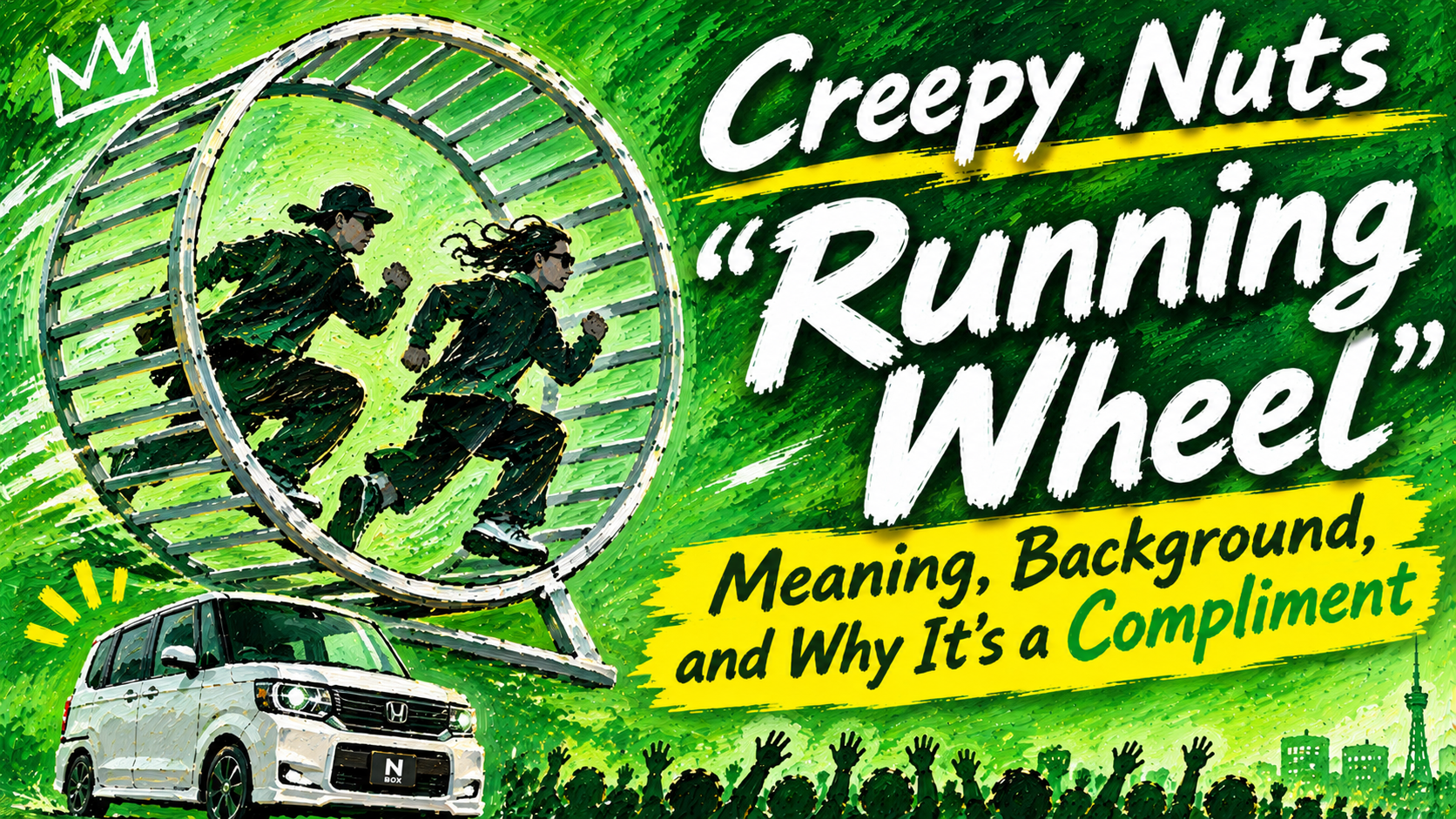
In English, a “running wheel” is the exercise wheel a hamster runs in, a symbol of effort that never ends and never moves you forward. But it can also mean the wheel of a car. Since this is an N-BOX commercial song, the double meaning is very likely intentional.
If you read it as the hamster wheel, the song becomes something more interesting than a victory lap. From the outside, Creepy Nuts look like they’ve reached the top, with Coachella, RIAA Gold, and stadium shows with The Weeknd. But if they stop running, it’s over, so they keep running. “No.1 while still challenging” can be heard as an upbeat way of describing a wheel you can’t step off.
To be clear, the Japanese word for hamster wheel (mawashi-guruma) doesn’t appear in the lyrics. This reading comes from the title alone, and Creepy Nuts haven’t officially explained it.
What Creepy Nuts Said About Making It
When the commercial was announced, the duo released this comment (our translation from the Japanese press release):
“Mainstream yet avant-garde, No.1 yet challenging. We felt that matched us exactly, so we turned recent events into lyrics!”
Note that the first half of that sentence describes the car. The N-BOX is Japan’s best-selling car, yet the commercial pitches it as trying something new, and the duo saw themselves in that. The English-language release puts it as pouring “everything we’ve experienced recently into the lyrics, while opening up a completely new musical direction.”
On the sound, DJ Matsunaga brought in elements of phonk, and the press materials call it a song that opened new territory in R-Shitei’s flow and expression. Kashiwa Sato, the well-known designer who serves as executive creative director for the N-BOX, said he believes “Running Wheel” will “take the N-BOX to its next phase.”
The underground setting of the music video can be read alongside that kemonomichi image. However big the stage gets, their roots are in small clubs and battle venues, and the video seems to say so visually. That’s our interpretation, but the contrast with the Coachella footage in the new film is hard to miss.
Cultural Note: Phonk
Phonk is a hip-hop offshoot rooted in 1990s Memphis rap, known for distorted bass and a gritty, lo-fi feel. In the 2020s it exploded online, especially in short-form video and driving or drift-car edits. That makes it a clever choice for a car commercial. It’s also a sound that global, internet-raised listeners recognize right away, which fits a duo now playing to audiences far outside Japan.
How Critics and Fans Heard It
In Japan, music critic Eriko Ishii reviewed the single for Real Sound and focused on R-Shitei’s delivery. She notes that he raps in a deliberately rough, shouty Osaka dialect, with the feel of a comedian rapping on sheer momentum, and compares it to GEISHA GIRLS. She calls it extremely funny, but “of course not a song aiming for laughs.” She says it confidently portrays where the duo stand now, Coachella included, and concludes that “both the idea and the result are unquestionably cool.”
Cultural Note: Osaka Dialect, Comedy, and GEISHA GIRLS
R-Shitei is from Osaka, a city famous across Japan for its comedians and its punchy local dialect (Kansai-ben). Osaka speech is closely tied to manzai, the fast back-and-forth stand-up comedy style built on a funny man (boke) and a straight man (tsukkomi). GEISHA GIRLS was a 1990s rap project by the famous comedy duo Downtown, and its delivery was full of comic swagger. When a critic compares “Running Wheel” to it, she isn’t calling the song a joke. She’s saying R-Shitei is using that brash Osaka comedian energy as a tool, and that it works.
Overseas, outlets such as Anime News Network covered the release and video, framing Creepy Nuts as a “global breakout” duo alongside their Coachella shows, RIAA Gold certifications, and The Weeknd tour dates. LiFTED Asia described “Running Wheel” as a chaotic phonk track steeped in Matrix-style nostalgia. It also pointed out that R-Shitei raps rapid-fire while changing his voice from section to section. Across English-language coverage, the song is mostly heard as a rags-to-riches story: from Japan’s underground rap scene to international festival stages.
The Takeaway: What “Running Wheel” Is Really Saying
“Running Wheel” writes Coachella into Creepy Nuts’ story, but it doesn’t treat it as the finish line. It starts on an animal trail and claims the title of “chosen one.” It nods to a champion wrestler who has to keep defending the belt, then ends by repeating its title like a mantra, still running. The message seems to be that being No.1 doesn’t let you stop. It means you have to keep challenging yourself, delivered over a distorted, aggressive phonk beat.
If you catch the tour film, whether in a Japanese cinema from November 20 or later, put “Running Wheel” on before or after. You’ll start to hear which words connect to which moments on screen.
FAQ
What does the title “Running Wheel” mean?
Creepy Nuts haven’t officially explained it. In English, a “running wheel” is a hamster’s exercise wheel, an image of nonstop effort, and it can also mean a car wheel, which fits the Honda commercial. A common reading is that it describes a No.1 act that has to keep running.
Is “Running Wheel” from an anime?
No. Unlike “Bling-Bang-Bang-Born” (Mashle) or “Otonoke” (Dan Da Dan), “Running Wheel” was written for a TV commercial for Honda’s N-BOX CUSTOM, a popular Japanese compact car. The ad began airing in Japan on July 16, 2026.
Does the song mention Coachella?
Yes. The word “Coachella” is in the lyrics, and DJ Matsunaga has said the song is about the duo’s Coachella and international experiences.
What is phonk, and why does this song sound so different?
Phonk is a hip-hop style rooted in Memphis rap, with distorted bass and a gritty feel. DJ Matsunaga built the track with phonk elements, and R-Shitei tried a new flow, including a rough, shouty Osaka-dialect delivery.
Who directed the “Running Wheel” music video?
Daiki Kamoshita, who also directed Creepy Nuts’ videos for “doppelgänger,” “Chudai,” and “Fright.”