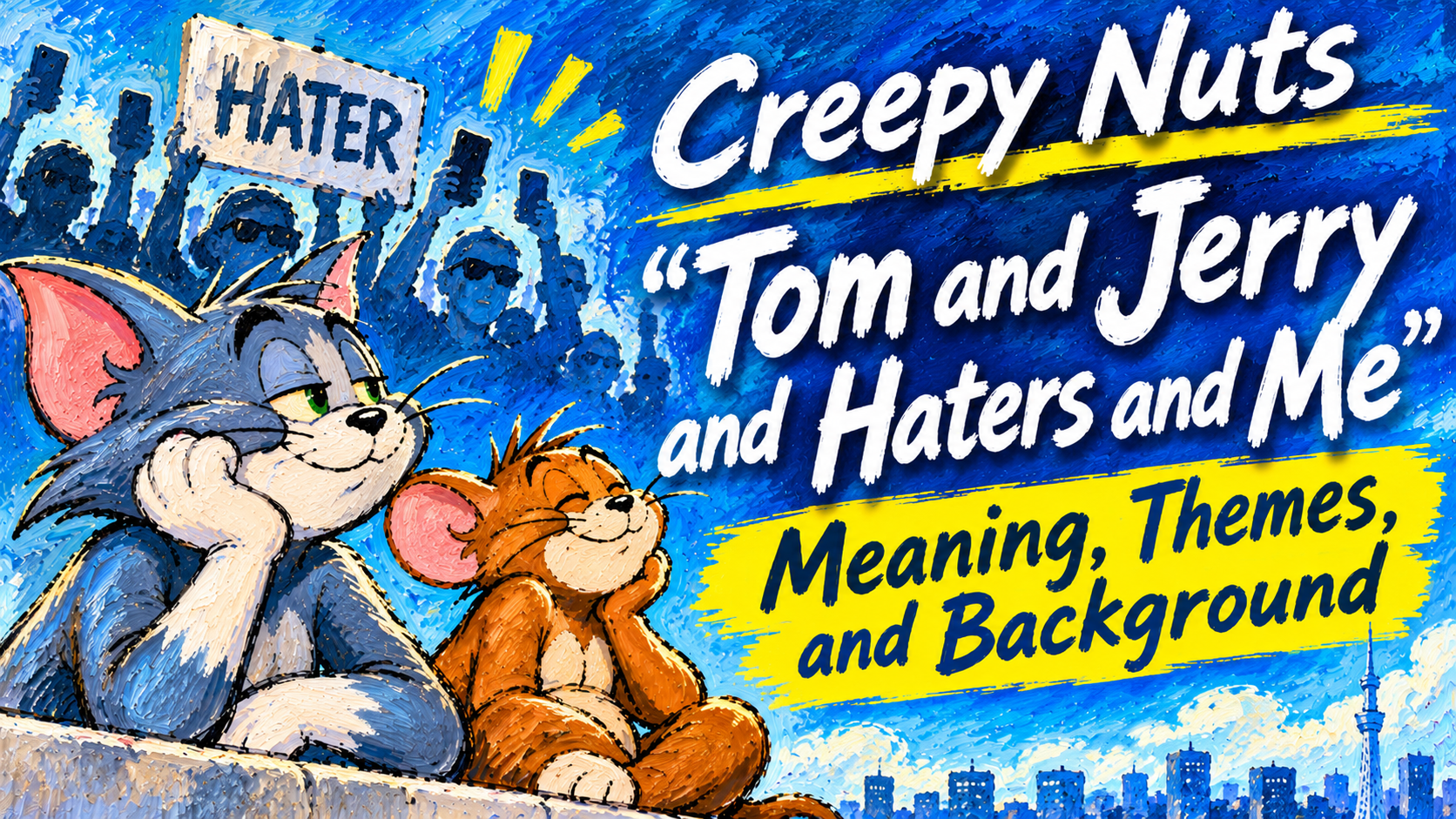
- A Surprise Drop That Got Everyone Talking
- Who Are Creepy Nuts?
- Song Facts at a Glance
- Where Creepy Nuts Were in 2026
- What Does the Title Mean?
- Lyrics Breakdown 1: The Haters Have Front-Row Seats
- Lyrics Breakdown 2: “That’s Not Hip-Hop”
- Lyrics Breakdown 3: A Chase That Lasts Until Death
- Lyrics Breakdown 4: Haters as Co-Writers
- Lyrics Breakdown 5: “We’re Two of a Kind”
- Fan Theories: “O Sole Mio” and Scorpion Shiratori
- Why Release It With No Warning?
- How Listeners Are Reacting
- Conclusion: A Song About “Fighting Nicely” With Your Haters
- FAQ
A Surprise Drop That Got Everyone Talking
At midnight Japan time on October 21, 2026, Creepy Nuts released a new song with no warning at all. No teaser, no countdown, no announcement. The title was “トムとジェリーとヘイターと私” (Tom to Jerry to Hater to Watashi), which translates to “Tom and Jerry and the Haters and I.” Major Japanese music outlets, including ORICON, Billboard JAPAN, and Natalie, all reported it as a “surprise release,” and the full track went up on YouTube the same moment it hit streaming services.
The title sounds like a joke. The theme is anything but. This is a song about the relationship between an artist and the people who criticize them, the “haters.” In this article, we’ll break down what the title means, unpack the Japanese wordplay and cultural references in the lyrics, and look at why this song arrived at this exact moment in the duo’s career.
One note before we start: as of release, R-Shitei and DJ Matsunaga had not published any official explanation of the song. Everything below is interpretation based on public information and the lyrics. You can read the original Japanese lyrics .
▶ Listen on youtube:
Who Are Creepy Nuts?
Creepy Nuts is a Japanese hip-hop duo made up of rapper R-Shitei (R-指定) and DJ/producer DJ Matsunaga (DJ松永). R-Shitei, from Osaka, made his name in freestyle rap battles, winning Japan’s biggest battle tournament three years in a row. DJ Matsunaga is a world champion turntablist who won the DMC World DJ Championships in 2019. Many listeners outside Japan discovered them through “Bling-Bang-Bang-Born,” the opening theme of the anime Mashle: Magic and Muscles, which became a global viral hit, and “Otonoke,” the opening of Dandadan.
Song Facts at a Glance
| Item | Details |
|---|---|
| Artist | Creepy Nuts (R-Shitei / DJ Matsunaga) |
| Release date | October 21, 2026 (digital single) |
| Lyrics | R-Shitei |
| Music | DJ Matsunaga |
| Tie-in | None reported (not an anime or drama theme) |
| Previous single | “Running Wheel” (August 19, 2026), written for a Honda N-BOX CUSTOM TV commercial |
The lack of a tie-in matters. Many of their biggest recent songs were written to fit the world of an anime or TV drama. This one isn’t serving anyone else’s story. It’s the duo talking about themselves, in their own words.
Where Creepy Nuts Were in 2026
To understand the song, it helps to know just how big the duo’s year had been:
- April: Their first North American tour. They closed the Gobi stage at Coachella on both weekends, played their first US headline shows in New York and Chicago, and wrapped up in Mexico City. The same month they released “Fright,” the theme song for the TBS TV drama Toki Sude ni Osushi!?
- August: “Running Wheel” released.
- September to November: Guest appearances on The Weeknd’s Asian tour dates.
- October 21: “Tom and Jerry and the Haters and I” drops without warning.
- November 20: Their first theatrical film, Creepy Nuts – NORTH AMERICA TOUR: LIVE in NY & DOCUMENTARY FILM, opens in Japanese cinemas.
- February 2027 onward: A nationwide arena tour in Japan.
In other words, this song came out when Creepy Nuts were more famous than ever, and, as always happens with fame, when the volume of criticism was louder than ever too.
What Does the Title Mean?
Tom and Jerry: enemies who can’t live without each other
Everyone knows Tom and Jerry, the classic American cartoon about a cat and mouse locked in an endless chase. But the show has a special place in Japan, where it aired on TV for decades and is remembered by generations of kids.
Cultural Note: “Fight Nicely,” Tom and Jerry
In Japan, the Japanese-dubbed TV version of Tom and Jerry had its own theme song, and one line from it became a well-known phrase: “Nakayoku kenka shina” (仲良くケンカしな), roughly “Go on, fight nicely” or “Quarrel like good friends.” For many Japanese listeners, the name Tom and Jerry instantly brings that idea to mind: two characters who fight constantly but are, in a strange way, close. That association is the key to the song’s title.
Tom and Jerry go at it for real every episode, but neither ever disappears for good. Without the other, there is no show. That’s the relationship the song draws between an artist and their haters.
Why “…and I” at the end?
The Japanese title strings nouns together with to (と, “and”): Tom and Jerry and the Haters and I. Putting “I” (watashi) last makes the narrator sound like just one more character in a noisy cartoon cast, as if he’s stepping outside himself and watching the whole circus from a distance.
Japanese has many words for “I.” Watashi is the neutral, slightly polite one, not the tougher ore (俺) that rappers often use. That choice adds to the title’s slightly deadpan, tongue-in-cheek feel, like the title of a picture book or a quirky indie film.
Lyrics Breakdown 1: The Haters Have Front-Row Seats
At the beginning and end of the song, the place where critics sit and heckle is described with words like “special seats” (tokutouseki, 特等席) and the “broadcast booth” (housouseki, 放送席). Instead of painting critics as enemies, the song casts them as the audience with the best view in the house, or as commentators calling the fight from the announcer’s desk.
That framing comes straight from R-Shitei’s roots in battle rap.
Cultural Note: Japan’s MC Battle Scene
Freestyle rap battles exploded in popularity in Japan in the mid-2010s. R-Shitei won UMB (Ultimate MC Battle), Japan’s top national battle tournament, three years in a row. He then became the first “final boss” on Freestyle Dungeon, a hit TV show where challengers battled their way up to face him. In a battle, the whole point is to take your opponent’s insults and flip them into something sharper and funnier in front of a crowd. Turning a back-and-forth of insults into entertainment is exactly what R-Shitei is known for.
Lyrics Breakdown 2: “That’s Not Hip-Hop”
Early in the song, R-Shitei brings up a familiar kind of criticism: every time Creepy Nuts score a big hit or break a record, someone says “that’s not hip-hop.”
Because the duo have had huge anime hits, regular TV and radio appearances, and success on J-pop charts, some hip-hop purists have treated them as too mainstream. What’s interesting is how the song answers this. Instead of trying to shut critics up with a comeback, it invites them to keep the argument going.
The song then lists symbols of wealth and fame, only to say the haters shine even brighter than all of that. The phrase “Bling-Bling” shows up here, and it’s hard not to hear a wink at “Bling-Bang-Bang-Born,” the song that made them world-famous. One reading is that R-Shitei takes the “bling” of global success and flips it: the real shine isn’t money, it’s the haters who keep the story alive. It’s sarcasm and affection at the same time.
Lyrics Breakdown 3: A Chase That Lasts Until Death
Later in the song, the feud stretches into an absurd future: the narrator and his haters keep at it into old age and all the way to the end of their lives, by which point nobody even remembers what the fight was about.
The haters’ refusal to let go is compared to a “loyal dog” (chuuken, 忠犬), and the day they both finally die is called “Shuusen Kinenbi” (終戦記念日).
Cultural Note: “Loyal Dog” and “End-of-War Day”
Chuuken (忠犬, “loyal dog”) instantly reminds Japanese listeners of Hachiko, the famous Akita dog who waited at Shibuya Station every day for years after his owner died. Calling haters chuuken is funny because it turns their obsession into a kind of devotion.
Shuusen Kinenbi (終戦記念日) is the Japanese name for August 15, the anniversary of the end of World War II for Japan. It’s a solemn date in Japan. Using it for the day an online feud finally ends is deliberately over-the-top, which is exactly the point: a feud that most people would treat as a passing flame war is stretched into a lifelong war with its own official ending.
By exaggerating this much, the song makes the weight of criticism feel ridiculous. But it also says something sincere underneath the joke: “I’m in this with you for the long haul.”
Lyrics Breakdown 4: Haters as Co-Writers
In the middle of the song, the narrator admits the haters get on his nerves every single time, yet he’d be lost without them. He even says he wants to credit them as a “co-write” (koraito, コライト), a co-writer on the track. Read one way, it’s a confession that criticism is literally what got this new song written.
One of the most striking ideas is the admission that critics, more than supporters, are what actually drive his writing. That’s a very honest thing for an artist to say. Praise makes you feel safe, but cruel words stick and replay in your head. The song suggests that this pain is, in the end, a source of creative energy.
Cultural Note: Shinken Shiraha-dori
The lyrics compare taking on the haters’ malice to shinken shiraha-dori (真剣白刃取り): the legendary move of stopping a sword swung at your head by clapping it between your bare palms. You’ll see it in samurai films, manga, and as a comedy bit on Japanese TV. Here it suggests not dodging the attack, but catching it head-on and getting back up, again and again.
Lyrics Breakdown 5: “We’re Two of a Kind”
Near the end, the narrator admits he’s no saint himself. He imagines that the hater, too, may be carrying loneliness or frustration, and instead of pushing them away, he chooses to face them.
The song closes by calling the hater “nitamono doushi” (似たもの同士), meaning “two of a kind” or “birds of a feather,” and agreeing to keep the endless chase going.
This connects to a theme Creepy Nuts have returned to again and again. In songs like “Katsute Tensai Datta Oretachi e” (“To Us, Who Were Once Geniuses”), they’ve spoken for people who were never at the center of the class.
Cultural Note: The Outsider Identity
Japanese slang divides people into youkya (陽キャ, “sunny,” outgoing types) and inkya (陰キャ, “shadowy,” introverted types). Both members of Creepy Nuts have long talked about being on the inkya side as teenagers, and that self-image runs through much of their music. When the song calls haters “two of a kind,” it suggests the duo see their own past selves in the lonely, bitter person typing angry comments.
So instead of pushing the hater away, the song can say: I know you, because I used to be you.
Fan Theories: “O Sole Mio” and Scorpion Shiratori
Some fans have gone even deeper.
One reading points to a passage that seems to echo the Neapolitan song “O Sole Mio” (“My Sun”) and calls the hater a kind of “sun.” The person you supposedly hate is also the light that shines on you. It’s the same twisted relationship, from another angle.
Another theory, from the Japanese blog upiupiupi, connects the song to Scorpion Shiratori, a pro wrestler in Takehiko Inoue’s manga Real. (Inoue is the creator of Slam Dunk and Vagabond; Real is his series about wheelchair basketball and people rebuilding their lives after injury.) Shiratori, once known as “Japan’s greatest heel,” becomes paralyzed from the waist down after an accident, yet returns to the ring and tells the crowd that he’s trash too. The blog argues that Shiratori’s way of taking every insult without flinching mirrors R-Shitei’s approach of turning haters’ malice into material.
Cultural Note: Heels and “Taking the Move”
In Japanese pro wrestling culture, there’s deep respect for a wrestler who takes an opponent’s moves fully instead of dodging them, called uke no bigaku (受けの美学), “the beauty of receiving.” A “heel” is the villain the crowd loves to boo. Both ideas fit neatly with battle rap, where you have to absorb your opponent’s best shot before answering it.
These are fan interpretations, not anything the duo have confirmed. But they add rich layers to the song.
Why Release It With No Warning?
Creepy Nuts haven’t explained the surprise release. But given the theme, one theory makes sense: if you announce a song in advance, people start judging it, speculating about it, and criticizing it based on the title alone. Dropping it without warning lets listeners hear the song itself before the outside noise kicks in. For a song about haters, that’s a fitting move. And of course, it was also simply a fun surprise for fans.
How Listeners Are Reacting
On Japanese lyric-analysis sites and social media, the most common take is that this is a paradoxical song that doesn’t try to get rid of criticism, but accepts it as a creative partner. Many listeners also say it’s a song they want to hear when they’re worn down by cruel comments online, so people are relating to it personally, not just as a celebrity’s story.
English-language music outlet SKREAM reported the release under the English title “Tom and Jerry and the Haters and I.” With so much of the song built on Japanese wordplay, it will be interesting to see how it lands with the overseas fans who joined after “Bling-Bang-Bang-Born.”
Conclusion: A Song About “Fighting Nicely” With Your Haters
“Tom and Jerry and the Haters and I” is Creepy Nuts, at the height of their global success, figuring out how to live with an ever-growing chorus of critics. In short:
- It treats haters not as enemies, but as partners in an endless chase.
- It calls criticism fuel and haters “co-writers.”
- It ends by calling haters “two of a kind” and reaching out to their loneliness.
It’s a song only R-Shitei, who turned trading insults into an art form in battle rap, and DJ Matsunaga, who built the beats behind him, could have made. Funny and defiant in equal measure.
FAQ
What does the title “Tom to Jerry to Hater to Watashi” mean?
It means “Tom and Jerry and the Haters and I.” It compares the relationship between an artist and their critics to Tom and Jerry: two sides that are always fighting, but can’t exist without each other.
Is this song from an anime?
No. Unlike “Bling-Bang-Bang-Born” (Mashle) or “Otonoke” (Dandadan), this song has no anime, drama, or commercial tie-in.
When was it released?
October 21, 2026, as a surprise digital single with no prior announcement. The full track is also on Creepy Nuts’ official YouTube channel.
Who wrote it?
Lyrics by R-Shitei, music by DJ Matsunaga.
Is there an official English translation of the lyrics?
No official English translation had been released at the time of writing. The original lyrics are available in Japanese