The lyrics are discussed and paraphrased here, not reproduced.
Want to hear it first? Listen to the song here.
On the surface, “Running Wheel” is a song written for a car commercial. Underneath, it is Creepy Nuts looking back at everything that has happened to them in the past year and refusing to slow down. Here is the story behind the song, what the title means, and the Japanese cultural context that helps it land if you’re listening from outside Japan.
Written for a car commercial, about their own career
“Running Wheel” was released digitally on August 19, 2026. It was written for a new Honda commercial for the N-BOX CUSTOM, titled “NEW IMPACT.” It is the first original song an artist has written specifically for an N-BOX commercial.
A bit of context for overseas readers: the N-BOX is a kei car, a category of small, tax-advantaged cars unique to Japan, and it has been Japan’s best-selling new car for five years running. Songs written for commercials and TV shows, known in Japan as “tie-ups,” are a huge part of the music industry, and they usually bend toward the brand. Here it’s the opposite. For a mainstream, family-friendly car brand, Creepy Nuts wrote an intensely personal song about their own career. That gap is part of what makes it interesting.
The sound: a push into Phonk
On the production side, DJ Matsunaga moved toward Phonk, a bass-heavy, gritty genre with roots in 1990s Memphis rap that was later reshaped by internet and car-video culture and has been booming worldwide. R-Shitei’s rapid-fire delivery rides on top. It sounds sharper, faster, and more aggressive than most of their earlier work. The duo themselves have said they poured everything they had experienced recently into the lyrics while opening up a completely new musical direction.
If you’re new to them: R-Shitei is a three-time national champion of Japan’s biggest MC battle tournament (UMB), and DJ Matsunaga is a DMC world champion turntablist. Their worldwide breakthrough came in 2024 with “Bling-Bang-Bang-Born,” an anime opening that exploded as a dance meme.
What “Running Wheel” actually means
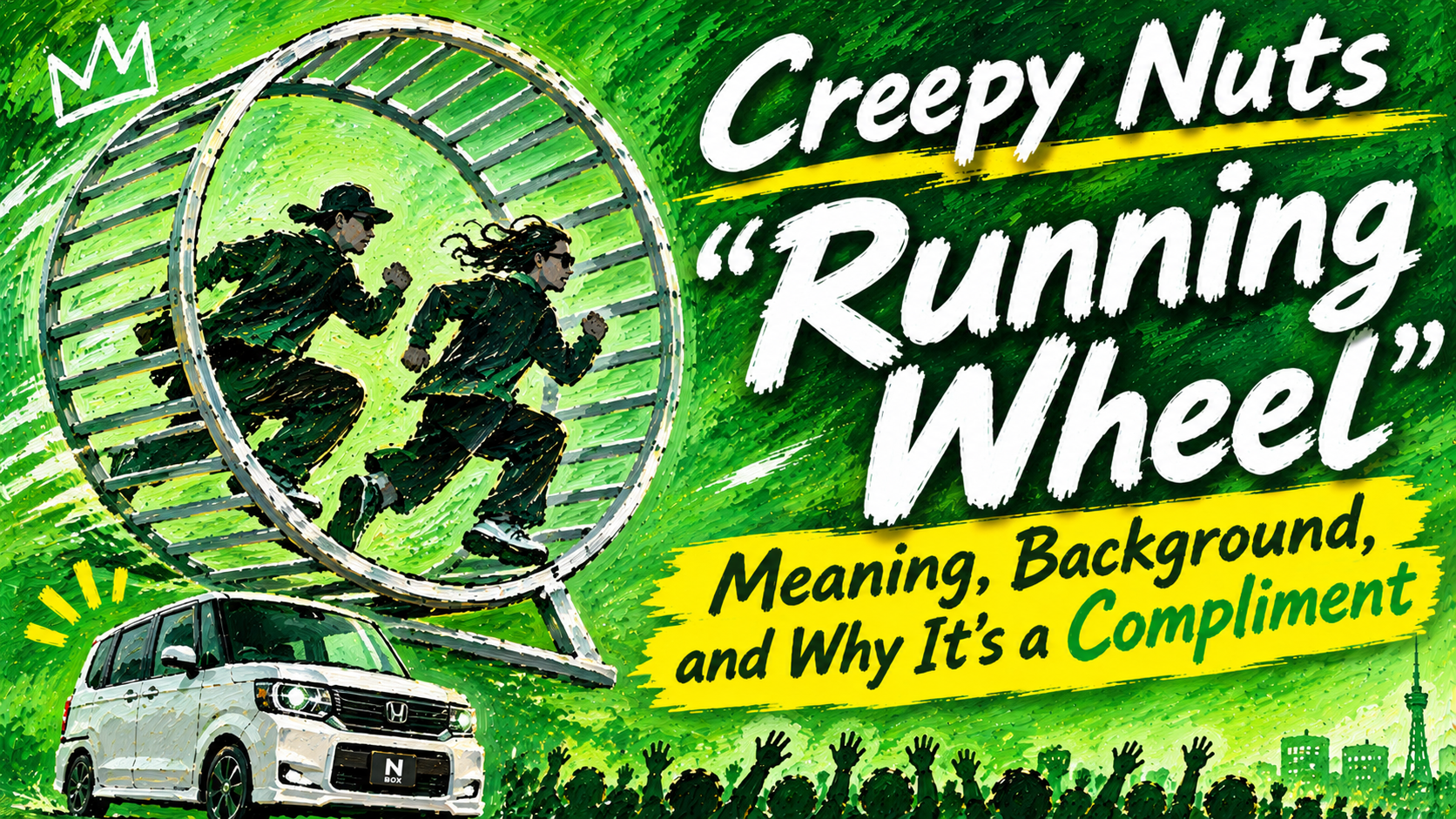
A running wheel is the hamster wheel: the little cage wheel where a small animal runs and runs and goes nowhere. On first read, the title sounds negative, like working hard and ending up in the same spot.
The song flips it. The idea behind the track is constant evolution, and the lyrics trace how the duo got from Japan’s underground rap scene to international festival stages. The hamster wheel becomes a symbol of not stopping.
What makes the image smart is the gap it captures. From the outside, someone on a running wheel looks like they’re stuck in place. From the inside, every step is real forward motion. The title takes that mismatch between how it looks and how it feels, and turns it into a statement of pride.
The second meaning: people watching from the sidelines
There is a second layer, and it needs a little Japanese vocabulary. The word gaiya (外野) literally means “the outfield.” It comes from baseball, and it’s used for people who aren’t part of the game but shout opinions from the stands. The lyrics take aim at exactly these people: they ignore the world’s judgmental stares, and tell outsiders who know nothing not to cut in.
That sets up a contrast. On one side are people who talk but haven’t moved. On the other are people who have actually run down a rough, untrodden path. The wheel itself fits the joke. Creepy Nuts are the ones who keep it spinning, yet to onlookers it can look like they’re standing still. The title holds both the frustration at that misunderstanding and the decision to keep running anyway.
A song built from the last 12 months
The past year has been remarkable for Creepy Nuts:
- In April, they closed the Gobi Stage at Coachella on both weekends, a first for a Japanese hip-hop act.
- Their songs “Bling-Bang-Bang-Born” and “Otonoke” each earned RIAA Gold certification in the US, making them the first Japanese artists to do that with two Japanese-language songs.
- In September, they began joining The Weeknd’s stadium tour across Asia as special guests for 11 shows.
The song pulls these experiences into the lyrics. For a Japanese-language rap act, that matters beyond bragging rights, because every one of these milestones is a data point in an ongoing question: how far can a Japanese-language hip-hop group travel? The words here come from someone standing inside that story.
A change in attitude
Earlier hits like “Nobishiro” (roughly “room to grow”) and “To Us Who Were Once Geniuses” (my own translation of the Japanese title) were introspective and self-accepting. They were about not being sure you’d make it. “Running Wheel” starts from the other side: someone who already has results. That’s a real shift in phase, and it makes this one of the more openly boastful songs in their catalog.
But it doesn’t read as simple bragging. The point isn’t “look how far we’ve come.” It’s “even after all this, we’re not stopping.”
Read it right after “Fright”
It’s worth listening to this song alongside “Fright,” released in April. “Fright” was about a person who has already achieved a lot, yet still feels fear before the next step. It didn’t try to erase that fear before moving on. It carried the fear forward.
Four months later, “Running Wheel” shows what happened next: they kept stepping, fear and all, and now there’s a track record to show for it. If “Fright” is a declaration that they’ll step forward even though they’re scared, “Running Wheel” is the evidence that they did.
Heard back to back, the two songs give you a snapshot of how the duo’s mindset has moved over this year, from the moment before the leap to the feeling of having kept running.
Key takeaways
“Running Wheel” carries several meanings at once:
- A picture of people who never stop moving forward
- A contrast with outsiders who comment from the sidelines without moving
- A statement that even if it looks like running in place, they know they’re advancing
It’s a commercial tie-up, but it’s also a snapshot of where Creepy Nuts stand right now, and a sign of where they intend to keep running.
Notes for readers outside Japan
- Kei car: A small vehicle class unique to Japan, with size and engine limits and lower taxes. The Honda N-BOX is the best-selling one.
- Tie-up (タイアップ): A song written for, or paired with, a commercial, TV show, anime, or film. It’s a major route to hits in Japan.
- 外野 (gaiya): Literally “outfield.” Used for people outside the game who comment from the sidelines.
- UMB: Japan’s largest MC battle tournament. R-Shitei is a three-time national champion.
- DMC: The DMC World DJ Championships, where DJ Matsunaga won a world title.
- Phonk: A bass-heavy, distorted hip-hop-derived genre that has surged in popularity online worldwide.