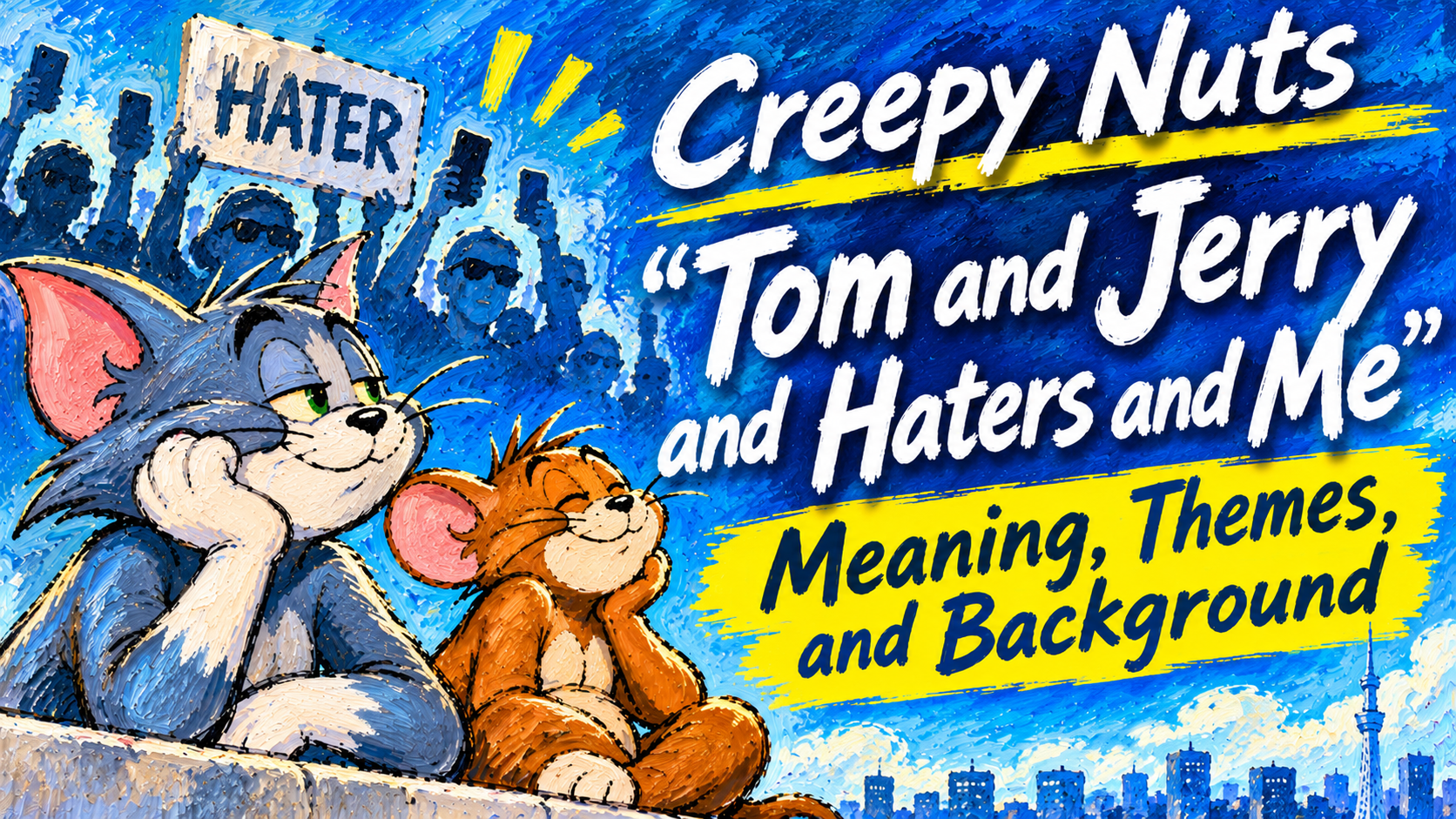
Note: “Tom and Jerry and Haters and Me” is a fan translation of the Japanese title 「トムとジェリーとヘイターと私」. The lyrics are discussed and paraphrased here, not reproduced.
Creepy Nuts have a habit of turning criticism into material. With “Tom and Jerry and Haters and Me,” they go a step further: they invite the critics in, call them co-writers, and imagine fighting with them until old age. Here is what the song is doing, what the title means, and the Japanese cultural references that are easy to miss if you’re listening from outside Japan.
A surprise drop with no warning
On October 21, 2026, Creepy Nuts released “Tom and Jerry and Haters and Me” with no advance announcement. It appeared on streaming services and as a full-length audio upload on YouTube at the same time. R-Shitei wrote the lyrics and DJ Matsunaga composed the music.
If you’re new to the duo: R-Shitei is a three-time national champion of Japan’s biggest MC battle tournament (UMB), and DJ Matsunaga is a DMC world champion turntablist. They broke through globally in 2024 with “Bling-Bang-Bang-Born,” the anime opening that turned into a worldwide dance-meme hit.
This is their first new song since “Running Wheel,” released on August 19 as the theme for a Honda N-BOX CUSTOM commercial. The timing is busy: since September, they have been joining The Weeknd’s stadium tour across Asia as special guests for 11 shows. More is coming too: their first feature film, a live-and-documentary film from their North American tour, opens in Japanese cinemas on November 20, and a nationwide arena tour starts in February 2027. Dropping a song with zero warning in the middle of all that gives it a guerrilla feel.
What the title is telling us
Tom and Jerry needs no introduction, but the way it lands in Japanese is worth explaining. There is a common saying, 喧嘩するほど仲がいい (“the more they fight, the closer they are”), and Tom and Jerry is often used as shorthand for exactly that kind of pair: constantly at each other’s throats, yet somehow inseparable.
By putting “haters” and “me” in that slot, the title recasts critics not as enemies but as a long-running, love-hate partnership. Before the first line plays, the song has already told you it isn’t a diss track. It’s about the relationship itself.
There’s also a small detail in the ordering. In the title, “Tom and Jerry” comes first. In the opening line of the lyrics, it’s the other way around: the haters and “us” come first, and Tom and Jerry arrive afterwards as a metaphor. You could read the title as a movie-style cast list that sets up a famous image, with “haters and me” gradually sliding into it. Either way, “haters” is named before “me” in both places, which fits the way the song treats critics as honored spectators and collaborators. To be clear, this is just one listener’s reading. The duo hasn’t commented on the word order.
Compared with “Running Wheel”
In “Running Wheel,” outsiders who comment without knowing anything are brushed off, and the narrator keeps running while they stand still. In Japanese, these onlookers are called 外野 (gaiya), literally “the outfield,” a baseball term for people outside the game who shout opinions from the sidelines. They are people to leave behind.
In “Tom and Jerry and Haters and Me,” the same crowd is cast as spectators in the best seats, watching through their screens. When they land a hit on something the narrator actually feels, the response isn’t anger. It’s a half-smile and a shrug. The August song is about leaving critics behind. The October song is about them running alongside you. In just two months, the same group of people goes from obstacle to companion.
The “that’s not hip-hop” loop
In the middle of the song, there’s a familiar routine: every time the duo goes viral, sets a record, or rewrites expectations, someone says “that isn’t hip-hop.” The narrator doesn’t argue. They joke that they’ll keep doing this until they die.
Some context helps here. Japan’s hip-hop scene has a long-running debate about authenticity, and artists who cross into the mainstream sometimes get hit with this exact line. Creepy Nuts have written anime openers and TV drama themes, and they’ve performed on NHK’s Kohaku Uta Gassen, Japan’s huge New Year’s Eve music show. Success on that scale tends to attract gatekeepers. The song treats this as a recurring ritual rather than a wound, and that ease sets the tone for the whole track.
Growing old together
The most striking move in the song is a jump forward in time. We see the narrator and the hater as elderly men: wigs, white hair, dentures, spitting as they trade insults. They can’t remember what they were even angry about, and they argue so hard that their grandchildren and great-grandchildren back away. The song goes all the way to the end: they burst a blood vessel and end up in the coffin.
Two Japanese references appear along the way:
- Hachiko. The hater’s loyalty is compared to Hachiko, the famous Akita dog who kept waiting at Shibuya Station for his owner for years after the owner died. In Japan, his name is shorthand for unwavering devotion. Here, it’s applied, with a straight face, to a person who attacks you online.
- The end-of-war anniversary. The song says their death days will be the day the war ends. In Japan, August 15 is remembered as the end of World War II. The most natural reading is that this “war” between narrator and hater only ends when they both die. The line is dark humor, but it sounds oddly affectionate.
Haters as co-writers
One of the most memorable moves is calling the haters “co-creators” and even joking about giving them a songwriting credit. The song admits that the writing flows more easily when the narrator is thinking about these critics than when they’re thinking about fans or friends. That can sound like gratitude or sarcasm, probably both, and it feels like an honest confession from a working artist. Criticism is not just noise here. It’s fuel.
There’s still some steel in it. The narrator says they’ll take even real malice head-on, like shinken shirahadori, the martial-arts technique of catching a sword blade between your bare palms, and keep standing.
Not enemies
The repeated address to the haters keeps reframing them as “not enemies.” They annoy the narrator freshly every time, and the narrator would still be in trouble without them. Both feelings are packed into the same chorus.
Near the end, the song talks to people it has never met, who somehow feel like kindred spirits. It tells them they can use the narrator as an outlet for a bad day. Finally, it admits that the narrator is a mess too, and asks, on days when nobody seems to recognize you, whether they want to vent. A song that opens with a cheeky jab ends with a hand held out to someone who is struggling. That final turn is the part most likely to stick with you.
Is Creepy Nuts hip-hop? One listener’s reading
Two things stood out on first listen. First, the writing carries some of the sharpness of R-Shitei’s earlier lyrics, yet the overall mood is much gentler. The way the song holds even a struggling critic feels almost paternal, a very different energy from the sharp, combative rhymes that built the duo’s name.
Second, DJ Matsunaga’s track doesn’t sit neatly inside the usual hip-hop mold. Put that next to the “that’s not hip-hop” joke in the lyrics, and the song starts to feel like an answer to the long-running question of whether Creepy Nuts are really hip-hop. The words laugh the accusation off, and the production declines to dress up in the expected genre clothes. Together they seem to say that genre isn’t defined by the people shouting from the sidelines.
Again, this is an interpretation. The duo has not said anything like this publicly. But the lyrics and the track appear to point in the same direction, which is what makes the song interesting.
Key takeaways
“Tom and Jerry and Haters and Me” has four faces:
- It reframes critics as an inseparable, love-hate partner instead of an enemy.
- It reverses the stance of “Running Wheel” in just two months, from “leaving them behind” to “running together.”
- It turns the endless “that’s not hip-hop” complaint into a joke by imagining the argument continuing until old age.
- Through both lyrics and production, it seems to answer the question “is Creepy Nuts hip-hop?”
It closes by turning toward people who are hurting, not toward the next victory. That gentler, more mature way of dealing with outside noise is a new look for Creepy Nuts, and it will be interesting to see how the song fits into the arena tour in 2027.
Notes for readers outside Japan
- 外野 (gaiya): Literally “outfield.” Used for outsiders who comment on something without taking part.
- 特等席 (tokutōseki): “The best seat,” like a VIP box. The song places the haters there, as spectators with the best view.
- ハチ公 (Hachiko): The loyal Akita dog statue at Shibuya Station, a symbol of devotion.
- 終戦記念日 (shūsen kinenbi): The anniversary of the end of WWII, observed on August 15.
- 真剣白刃取り (shinken shirahadori): Catching a drawn sword between your palms.
- 喧嘩するほど仲がいい: “The more they fight, the closer they are,” the Japanese equivalent of fighting like an old married couple.